


I am loathe to throw or abandon tools that have served me well. Increasingly the concept of long ownership is out of favor, as we are driven to constantly evolve and improve while subscribing to services that enrich the globo-corpo Bros at greater expense. Ironic, isn’t it, that progress has become less efficient for us and more beneficial to a select few.
With modern tools, you really are selecting a battery platform that locks you into the product line. Many gurus advise you to think through your future needs. Vendor lock-in is fairly common because the chargers and the batteries are expensive, and most times you are sold the charging platform with a choice of 1-2 tools. If you’re willing to buy into the brand you can get some good deals, in some cases a tool for $299 can be yours if you catch the sale. But now you’re committed. Many make this work, but that’s just not me.
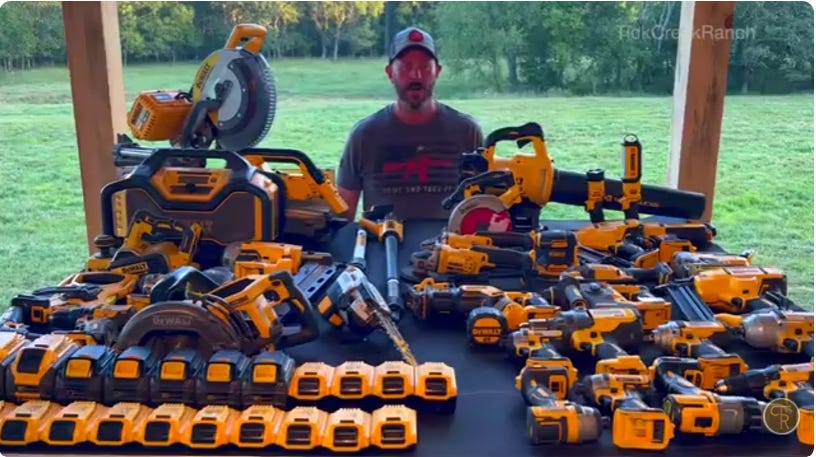
I am old school, and prefer corded or pneumatic tools, and I don’t notice the inconvenience of cords up on a ladder, I’m too set in my ways. I am terrible at remembering to keep batteries charged, and I hate it when working out in the cold and the battery drains faster, or worse, dies in mid use. I admit that with older batteries I am getting a inferior experience, but I hate the thought of having to have ALL black and yellow tools based on battery requirements alone. Sure some lines allow interchange, but others don’t and you void the warranty. You’d think that among the same manufacturer your battery for your circular saw would new interchangeable with the air-blower from the manufacturer, but that’s not always the case.
Trust me I get the convenience and speed you can get with the batteries, and it makes sense if you want to streamline tasks between drilling and sinking, and you have a tool staged for each, it’s short term and switching out the cord would be a waste of time. Coming from the 80s where we did not have nail guns for framing, there were times things slowed, so efficiencies are welcomed, but most lines of tools do not have the ability to alternate between corded juice and the battery. Metamorphosis offers this, and for the owner that’s the best of both.
The other lines are clearly going to vendor lock in.
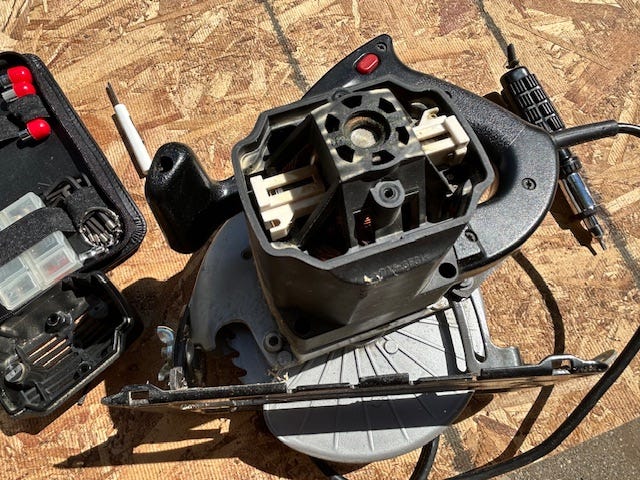
My Skil 5150 that I’ve had since 1993 died on me. Mid cut. I’ve avoided joining the DeWalt Dominion, the rebranded Black and Decker with safety colors. And while I like the Makita tools I see some of the Japanese woodworkers deftly use, I didn’t want to have to embrace a new platform. I want a tool, and not have to consider a suite of battery charges because the color of my router is different from Skilsaw or my sander.
With my 5150 down and out and in mid project I didn’t want to spend hours trying to resuscitate it, so naturally I wanted to check prices and see what I was in for if I laid my Skilsaw to rest. After searching online I noted only Harbor Freight had corded and brushed motor circular saws I could pick up. Everywhere else was ONLY brushless and cordless. Except for the Makita at $200! This drives me insane, wandering the decision matrix of expense vs buying something cheap that may not last very long, which also drives me crazy. At the time delivery to stores was a day or two.
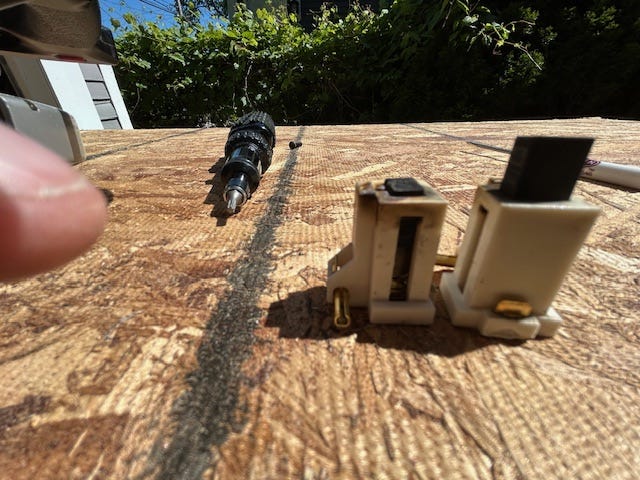
So I did what I should have done immediately and ordered replacement brushes for the 5150 in hopes that was the issue. I figured I’d take a chance and hope it was an easy fix. I feel like the Omega Man who refuses to join the Family. Or perhaps I’m a stubborn and pedantic old crow. Could be a bit of both.
5150 - What’s the Big Deal?
Most of our tools today are assembled overseas, with approximately 60% split between two facilities in China. It’s a sad state, because we used to make what we needed in this country, and Skil pioneered the circular saw. By habit I call it a Skilsaw, I guess it’s like saying “can you Xerox that for me”. Our outsourcing of our inflation by moving manufacturing overseas has served consumerism well, but it’s gutted our tradition of innovation and PROMULGATING ingenuity by making what we need. There’s a creed to that which helped us build lasting things. I hold that as the antithesis of corporate mentality which has manifested into today’s foolish convenience.
When I bought the 5150 in 1993, Skil was still made in America. Ironically that’s the same year as the movie Rising Sun, based on Michael Crichton’s novel about the threat of America allowing ownership to fall to foreigners and the clash of our cultures due to a willful ignorance of how other societies thought about our way of life. It’s not why I bought the tool, I purchased it because it was what I had when working with dad. But my 5150 has survived 34 years.
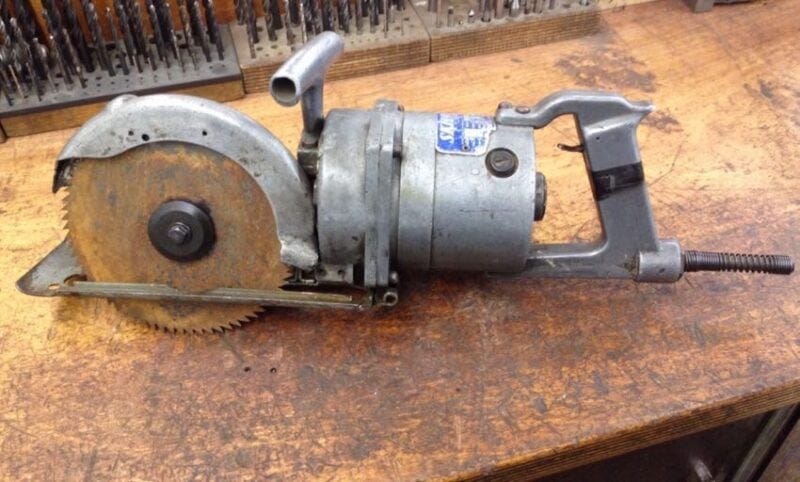
The Skilsaw was the innovation of Edmond Michel, a French engineer who immigrated to the United States at the turn of the 20th century, and prior to his work on the hand held circular saw he patented designs for a rotary hand planar and later a motorized hand plane. In Louisiana he was inspired to create a more efficient method for cutting after observing sugar harvesting and the manual effort to cut the stalks with a machete. Like many with an inventive and inquisitive nature, Michel thought he could make things better, and set off to try. This was not the product of an institution, but the idea of an individual, determined and driven. In 1923 he fashioned the “world’s first electric handsaw” and in 1924 he partnered with investor Joseph Sullivan and produced the first Skilsaw based on the worm drive design. In 1926, Michel left and Sullivan carried on manufacturing the Skilsaw, and grew the company.
The Skilsaw revolutionized the construction industry. The Skilaw 77 became the signature product and was considered the tool for a professional carpenter and builder to have. This was a tool that enabled one to perform effectively on jobs sites and facilitated several booms in housing construction. Skil expanded into other lines with electric drills, drivers, grinders and other professional grade tools, and dominated the professional tool industry for decades. Skil expanded into the European market in 1961 with a production facility in the Netherlands, and produced its 10 millionth tool 1966. This is an era when quality was the primary facet of a product that would endear a tool manufacturer to their customers. It meant something to empower someone to get their job done.
Companies come and go, and even innovators fall to time and change. Skil was eventually purchased by Bosch in 1996, and given the success of Skil and the loyal population of owners, the brand name has been maintained. This has bought about the development of two distinct consumer and professional markets. In 2014 Skil was sold off to Chervon, a Chinese company. The brand continues today, and based on my meager judgement, the quality of tools has been maintained. I own the Skil 15 amp Router (corded of course) and just replaced my table saw with the Skil 15 amp corded jobsite saw.
My instincts are to keep things as cheap as I can, I like to make my own jigs instead of dropping tons of cash at Rockler or elsewhere, and I like to stick with a line of products that I know. That doesn’t mean I don’t salivate at some great tools that are made, but I keep a tight budget. And given that the choice today is more of a platform selection than a single tool choice, I bide my time before buying. So I have to try to fix and make due with what I have. I’m wired and weird like that. I got lucky with the 5150, it took 10 minutes to pop in new brushes and it was back in production.
250 - What’s the Big Deal?
We are rapidly approaching our 250th Anniversary as a country, and with the advent of a class of elite “trash it, break and just build something new” globalists, we are no longer afforded the position of deciding what we want for our society to be as it enters the next phase. Many paths don’t point to another 250 year run, not with us in charge of our own destinies.
There’s an analogy I’m going to draw here with my 5150: we are being herded into product line silos that are treadmills of fealty. Your political leadership wants to also preclude you from economic choices, or at least narrow the field of choices of endeavors to align with what benefits a technocratic cabal. You’ll get a choice of selecting a product line of outcomes. Choose MAGA and you’re supposed to support data centers and property acquisition via eminent domain. Choose New Green Deal and you’re supposed to support solar and windmill farms gobbling up property via eminent domain.
I know my perception is colored by my choices of reading and news reading habits, but when I pull back to “hey, why not try fixing and preserving” I don’t see that as something that is considered viable. To survive the 21st century, the new mantra is we need entirely new systems, and there are consequences we have to ignore. Get on board. Everything is a movement, meaning there is a new creed you have to adopt. Destructive capitalism or “break things and move fast” is required, but that is only afforded to a select few, and those peeps are very awkward individuals that would perhaps make you very uncomfortable if you interacted with them on an interpersonal or professional basis. But set your instinct aside. You must, or you will be left behind. Other prominent groups still claim destructive social engineering is needed, where the concept of law enforcement, healthcare or rural life must be re-imagined. Dewalt, Makita or Ryobi. Buy into a product line, but there’s little room for your own innovation. And jumping to other lines is discouraged.
Or perhaps it’s the case that you are going to wake up in a society where you work to pump money into services instead of owning anything, and to remain in good stead while on that treadmill, you shouldn’t repair, you upgrade because that’s what everyone does. Smart people outsource their problems, the details are better solved via specialization, you can just buy the new thing.
That doesn’t serve us well, or at least I don’t think it serves me well. What grabs the headlines? AI and how energy policy needs to adapt to spawning more AI. It overshadows what we need to do with manufacturing, it crowds out the fact that in many states the median age of carpenters active in home building is 58. My neighbor, a recently retired electrician, relays the same scenario: we do not encourage skilled labor and skill technical work as
Your Patriotic Duty To Embrace Vendor Lock In
Vendor lock in is a concept that we’re going to encounter on a different scale, I’ve seen inklings already. In Becoming a Felon with CNC Machines and 3D Printing we examined what consolidation is happening with 3D printing, the vendors that are working with New York and California are providing the operating arena where your files will be scanned and you will be kept in good stead with your government. It’s how you will make 3D objects. While companies like Bambu and others who are happy to comply with the government are getting tremendous pushback from customers, switching out your operation if you’ve depended on a device for fulfilling orders and running your business is a form of vendor lock in.

Mr Wonderful, Kevin O’Leary, just showed me the light as to how I was a Communist for wanting details on how data centers will impact my state and the Great Lakes. But just a few weeks after O’Leary’s “bombshell” revelation and Red Scare Shaming of data center protestors with allegations of CCP funding, a video of Jensen Huang from November 2025 has been recirculated. Jensen, CEO of NVidia, producer of the same chips that will go into the data centers that OpenAI and Anthropic have pledge 100 billions in capital expenditure to building, demonstrated a new product line called the Jensen Nano that will undermine the data center strategy. The Jensen Nano, for $249 dollars, will operate up to 70 Trillion parameters when processing AI requests. Think of a parameter as a sticky note. You use the sticky note to store bits of details of reminders for yourself, such as “Add milk to the shopping haul”. Once shopping, the sticky note helps you remember the milk. A parameter is the akin to sticky note, the more you have the better your performance for your AI processes.
The compelling reason to use OpenAI and Anthropic, frontier leaders in AI, is that they offer a robust processing environment that smoothly answers your questions with your ChatBot, or produce a video or run a process writes software for you. Or at least that is their claim.
What Jenson revealed was that OpenAI and Anthropic will not be needed. In the past I’ve written about free open source alternatives to the Big Two AI Guys and that they are the bigger threat to the moat that Anthropic and OpenAI have erected to guard their market positions. The Mac Mini has also been flying off the shelves to be used in small AI labs, given that it’s architecture is conducive to efficient AI processing. For most tasks in business such as collating emails, spotting trends, reading invoices, you are looking at a one time cost of $599 for the Mac and $3 per month in electricity as opposed to monthly service subscriptions. For Stacey usage that can be $459, and some have reported that with the Big Two AI, they have received surprise notifications that they have burned through a month of usage in a mere 4 days. One savvy individual has created a small processing cluster with 30 Mac Mini’s. You could say that this decouples the concept of AI and large data center processing.
For most professional needs, there are cheaper alternatives than the Vendor Lock In world that Open AI and Anthropic want you to join. Alex Karp, CEO of Palantir, urges all to adopt a mindset that values national projects with higher goals rather than your being able to earn a dollar more efficiently. How long until they tell you that someone who wants to cobble together something that is good enough is not acting patriotically, how long before it’s our duty to ensure that the companies that are the leaders are supported as critical infrastructure themselves? Your looking to avoid vendor lock in does breach their moat.

These small solutions where people test the limits of their ingenuity are a threat to the Big Moat that protects the Big Two. That used to be our creed - repair what you have, innovate with less, it makes you more capable later on. I don’t think that’s the case with the large data center push to win an imaginary path to spawn Artificial Super Intelligence. Whatever they do produce, we won’t likely be able to use because the Bro-ligarchs themselves say it’s too dangerous for us unwashed mortals to wield.
Why Draw The Line And Meet Them Half the Way
Always one more
You’re never satisfied
Share one for all with you
It’s only one for me
Oh, why draw the line?
And meet you half the way
And you don’t know what that means
5150, Sammy Hagar
We can’t give up our tenacity, as it breeds our alacrity. That’s one of the most important ingredients of the first 250 years of our country. Or at least that’s what it has meant to me. Favoriting ability over pedigree. Every. Single. Time. It means relying on the skills, habits, and sense of stewardship that you develop to fulfill your calling. That calling may be being the best parent you can, it may be being a mentor, or perhaps the best orator to light fire in the minds of people. It may be to remind people that Natural Law and God is where we derive our rights, and also where we have to put our attention toward.
The Futurists, the Technorati, the Bro-ligarchs rarely mention that facet of our culture. Very few moments are spent reflecting on our long history of achievements, which are considerable after 250 years. Nor on why we could flourish on our own without large systems and national programs. It’s all future gazing.
Ask yourself if their plans are so sound, why they can’t leave us alone, why there is no compromise? Ask why is this vague goal of victory is so important if they can’t concretely tell us what that goal looks like, and why they need our attention, our money, and our water. If they can’t compromise with allowing freedom and perhaps our forging better ideas than huge Hollywood style launches of data center initiatives, then why should we meet them half way? If their vision of the future is the only future, that’s no choice.

This resonates with me. Just the last few weeks I've been doing some serious cleaning/organizing under my modest homes where I have some storage and a decent "work-space". I really have a hard time getting rid of tools/equipment even if they are redundant - I mean I have a hard time throwing a screw in the trash can if it is still functional!
Saw your note today and thought I'd check out the place - I haven't read this article in full, but I also........ "am loathe to throw or abandon tools that have served me well" ...... I even have trouble getting rid of ones that only seem to have potential use in the future. It ends up mainly being about space for tidy storage I reckon.
I think I need to post an article on this at my Substack place - regarding the space under my homes and the tools/equipment stored therein after many hours trying to tidy things up.
Regards,
BK