Medium Men
Is Cloudy Thinking The Only By Product of Social Media Algorithms?

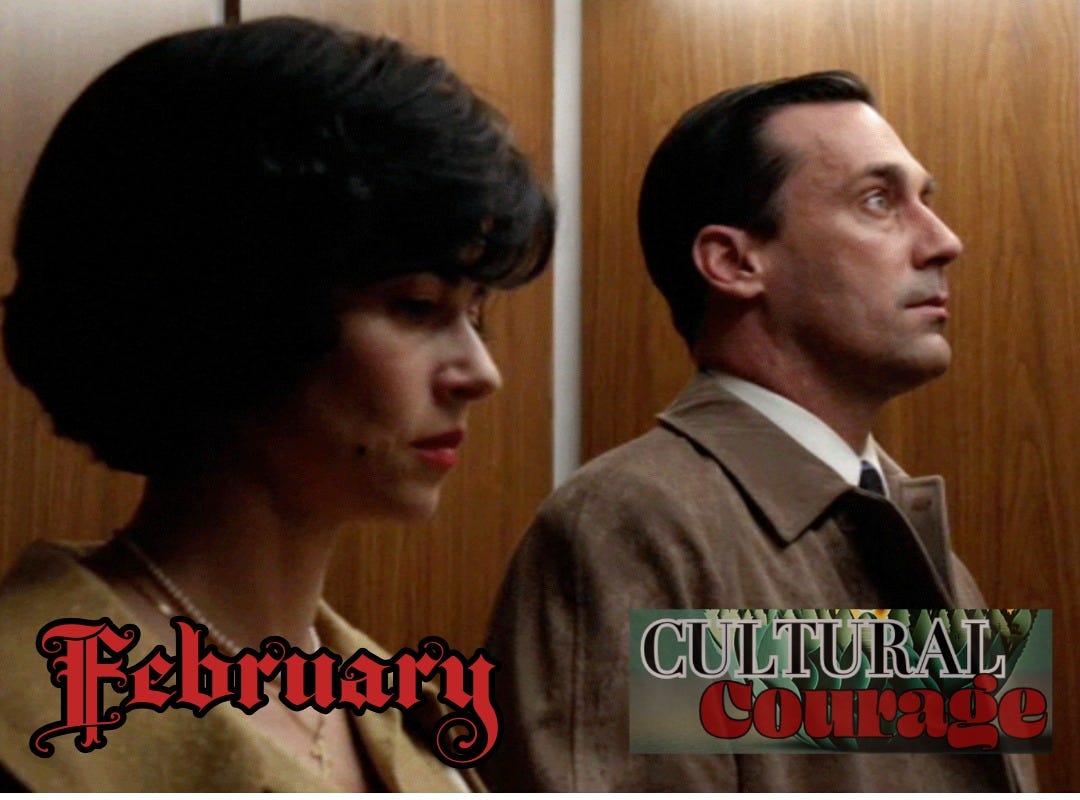
In a culture like ours, long accustomed to splitting and dividing all things as a means of control, it is sometimes a bit of a shock to be reminded that, in operational and practical fact, the medium is the message. This is merely to say that the personal and social consequences of any medium—that is, of any extension of ourselves—result from the new scale that is introduced into our affairs by each extension of ourselves, or by any new technology.
Marshall McLuhan
I had a thought earlier. Now it’s gone. Hence I am typing to get my mind going while it still has a process of its own volition. If you sense that I am talking about myself as though I’m observing something that is separate from my active consciousness, let me tell you it’s on purpose. Normally I cringe at the thought of being out of control. Outside influences are what can trigger Severed Conscience, a state where you become so absorbed in social media that you lose your abilities to rationally process information and form judgements of your own.
The echo of the idea was for a topic regarding input deluging the brain to the point where the brain shuts down. Algorithms and habituation to eagerly seeking the novel in the guise of learning nabbed me again. Deluge, dilute. The Yin and Yang of the Bro-ligarchs and the Trendies.
And now I may not get back to that idea. It’s pitiful. It’s demoralizing too, because I could formerly jump into tasks, lose myself in the flow and be highly productive. That was highly addictive but in a good way.. Now my habits are terrible - I switched from social media in the first hours of morning because it’s too depressing seeing the same ideas ratting around like the seagulls in Finding Nemo all raising their heads and crying out “Mine?! Mine?!”
“Entrained” is the term used to describe that behavior. By being entertained we become entrained. Entrainment is the act of your brainwaves synchronizing with an external, rhythmic stimulus. It happens passively because of how our brains function. It happens in church, it happens when you sit in a room and slowly your pulse synchronizes with others seated with you. It happens when you’re singing in choir. Entrainment was part of our focus in Severed Conscience.
But your mind is now synchronized with what? If you’ve been scrolling and catching up on the news, your mind has been in a passive beta state while images played across your eyeballs, and you sit there your habits and proclivities have been studied by your app as it records how long you linger on a video or graphic. There is a reward cycle that plays out interspersed with adrenaline that subjects your mind to images, emotions in patterns and cadences not of your making.
It’s ruined my concentration, and even though I reframe from social media in these early hours, YouTube is now my new habit. I’ve merely replaced my source of stimulus with another.
My hope was that by cranking out a few lines you’ve just read here I would trigger the thought again without going back to my YouTube history. Here it is: not only is AI crowding out actual writing, creating and thinking with the volume of sludge content, we are conditioning ourselves to do the same with our media consumption, just at a slower pace.
Mad Men and The 1960s Prophet Marshall McLuhan
I never understood Marshall McLuhan’s catch phrase “The Medium is The Message” and still don’t at my young age of 60. I think because of that I have actually passed the test. “The medium is the message” always felt like some cool kid nonsense that annoyed me because it was just so inane. And mildly accurate. It seems like a vapid Don Draper vision quest bromide. Hear me out.
I am being very literal and in the first paragraph of McLuhan’s essay of the same name, he stakes the claim that the storyline or content of the media I am watching does not shape me or alter my senses as much as the delivery mechanism itself. The TV show, video or film is not as relevant as the effects that TV has on me. I sit, transfixed, in a passive state as ideas are sent from afar into my head. It’s a bit different than doom scrolling, because with TV there is an element of longer form concentration. But that is if I don’t have a mobile phone with me while I watch. I am a passive participant in a collective event as my program delivers social mores, desires, tweaks my appetite with commercials for beef jerky or nauseates me with an Ozempic commercial.
All of this is an effect, not a message.
McLuhan would have made a much stronger case without all the pedantic mysticism and poorly constructed examples. I express frustration here because we do see the effects of media on our thinking, and from social media in particular. But given my reaction to McLuhan, I think his ideas are clouded by his abstruse presentation.
Clearly there is a deeper implication with this effect media has on us, but that is not the message of the TV / Streaming medium. And it’s not a meta-message either. I think of it this way: if the medium is the message, and the stimulation and effects are what work a greater impact on me resulting in fatigue, man-boobs from sitting on the couch, pale skin and bleary eyes, then no one would want it. Unless they became addicted to entertainment that is.
Harvesting Minds: The Reverse Gutenberg Process

Without social media many of you who enjoy the writing and analysis of OZFest, Cultural Courage and Severed Conscience would not be reading this article today. In fact many of those kind of enough to subscribe have come from the social media function Notes in Substack and from social media platforms likeTwitter. I do want to point out that I think Sub…
Sever the Roots, Topple the Tree: Tech Bros Destroy Us with “Move Fast, Break Things”

When the roots of a tree are severed, that tree, no matter how mighty, falls to the ground. I use that analogy in conjunction with the image above to emphasize that we take it for granted that others think about the consequences of their actions. Some actions axiomatically result in destruction. Sever the roots of a tree, it dies.
The Risks of Sharenting

Before I begin, I will admit that I found this article difficult to write. I have two grown kids, 22 and 19 and and my wife and I shepherded them through social media, online drama and screen habits. But I don’t want to preach, I only write from my the challenges we faced with our our children, and somehow those travails prepared us for managing social media more easily. And I think it’s important for the reader to know that I don’t think that parents who share photos, videos and post about their kids achievements online excessively do so maliciously, or are attempting to outdo families and neighbors in their communities. My point about writing about online sharing is that we may not be aware of how much harm we could be doing by posting our kids lives online in such detail. So this is an invitation to reflect on what you are doing, and not a judgement against your decisions.
Perhaps the message implied from the communal ritual of media consumption is a shared culture of happiness, horniess, discovery and a fun time, but those are the results of the content, and not the mechanics of the screen in your living room. I feel like I need Don and Peggy from Mad Men to come and hypnotize me again as they deliver the self congratulatory context of why I should want something. I think this is the spirit of “The Medium is The Message”, that there’s far less there actually there, but I need handsome people to placate my urge to walk on.
There is no denying that there are deleterious effects of TV/Streaming/social media. They are abundantly clear as documented by Jonathon Haidt and many others. But who is McLuhan’s message really for, the consumers of media or the consumers of the viewers, those who want to garner eyeballs, clicks and all the other mechanisms that track our behavior? Sounds like someone such as Sean Parker of Facebook would be the target audience for the message. The medium is the message is a trippy phrase that makes those who can repeat feel like they are in the insiders club, it’s something that the advertising and marketing types would like to spout as they go about working with their studies and demographics. But for me the cryptic phrase and cognitive friction over “effect” vs “message” is an intentional dodge, as it grants wiggle room that allows for a brow beating. “No dumb-dumb, you’ve missed the point entirely” and another version of word salad follows. A tapestry of ideas, but still the foundational message is pretty murky with this sloppy thinking.
I am going to run through a few samples.
In terms of the ways in which the machine altered our relations to one another and to ourselves, it mattered not in the least whether it turned out cornflakes or Cadillacs. The restructuring of human work and association was shaped by the technique of fragmentation that is the essence of machine technology. The essence of automation technology is the opposite. It is integral and decentralist in depth, just as the machine was fragmentary, centralist, and superficial in its patterning of human relationships.
I could be missing McLuhan’s distinction of automation technology vs machine technology. The automobile, by its nature, is the sum of its parts. Does he imply the fragmentation or breaking down the production of an automobile into discrete actions performed serially as fragmentation? Automotive manufacturing is certainly not decentralized, clearly not when you consider the large automakers. Sure, in Italy, there were some great cars made in small shops but decentralized? I sense an artificial tension he’s trying to establish in his obtuse dialectical thinking, peppered with shallowly detailed examples from man’s technological history. And if automation technology is to include social media, that is NOT decentralized. You have huge hives, with a select group allowed to operate at full autonomy. Specific to McLuhan’s time when he wrote Medium is the Message, entertainment was very centralized, the viewing of that entertainment was communal in that you had to congregate in theaters at specified times, or the nation watched TV programs at the same time in huge numbers.
Ever use a tool for a purpose other than intended, because in a jam you were up on a ladder, or didn’t want to go to the Big Box store and buy yet something else? What does that mean for the “message” then? A tool has no message. You may detect its purpose, or you may find that you have other better ideas. Do you congratulate yourself on your ingenuity in a pinch, or the fact that you have broken with social constructs that supposedly infuse everything?
If it is asked, “What is the content of speech?,” it is necessary to say, “It is an actual process of thought, which is in itself nonverbal.”
Um … speech is also auditory, it is also used in conjunction with facial expression and motion of the body. Thought infuses that activity. It’s ridiculous that McLuhan dissects an element, and excludes other important facets of that element to narrow in on his point. Which at this stage in his essay seems to still draw from this mystical vision quest.
And Dakara sums up speech very adeptly in his post AI Prompt To Movies Will Never Happen

Words are not our thoughts, but are merely low-fidelity abstractions of the processes that are within our minds. It takes time to manifest our visions from our thoughts using all the modalities available. There are no shortcuts that preserve the precise intent of our ideas.
A Lack of Understanding of Centralization
For it is not till the electric light is used to spell out some brand name that it is noticed as a medium. Then it is not the light but the “content” (or what is really another medium) that is noticed. The message of the electric light is like the message of electric power in industry, totally radical, pervasive, and decentralized.
NO! The electrical grid is VERY centralized. And what about the same advertisement using light to convey the ad that has been mass produced such as Coke signs? When word salad does not convey a coherent message, it’s babble. Ignoring facts central to points cited to support a theme is merely making loose associations. It is babble.
And maybe I should be rightly concerned about my comprehension and level of concentration, because the more I read McLuhan’s word salad Zen “The Medium of the Message”, the less confident I became that I could explain what he was talking about as his illustrations are assertions only, and this weird infusion of opposites that mean the same thing and yet not that thing, but are also a footprint of something else is not helpful, it’s confusing.
Just before an airplane breaks the sound barrier, sound waves become visible on the wings of the plane. The sudden visibility of sound just as sound ends is an apt instance of that great pattern of being that reveals new and opposite forms just as the earlier forms reach their peak performance.
His idea that you see the sound before breaking the sound barrier is a wild stretch. You don’t see the sound, you see the vibration as it moves the air and displaces water vapor and gas. You see the indication of what is happening, you see the ripples, but those are caused by the sound. Prior to this example, he claims that David Hume’s idea that sequences do not demonstrate causality as he discusses the sequence of breaking the sound barrier. It does not strengthen his point with this fusion of opposites in this constant Hegelian dance.
As Norm from Cheers asked during Frasier’s reading of Dickens
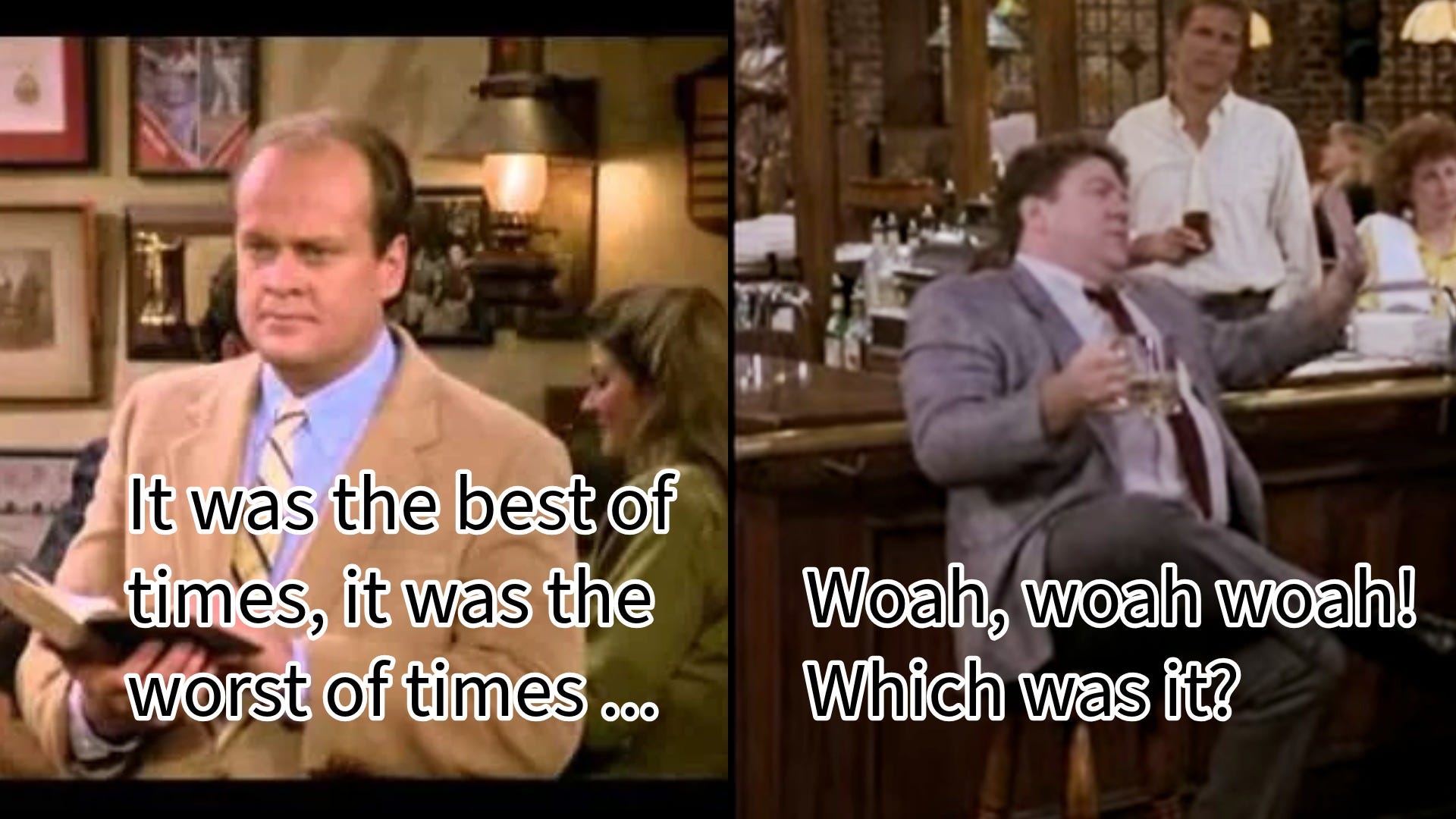
Maybe I really should be sitting in a bar instead writing this, I dunno.
For the “content” of a medium is like the juicy piece of meat carried by the burglar to distract the watchdog of the mind. The effect of the medium is made strong and intense just because it is given another medium as “content.” The content of a movie is a novel or a play or an opera. The effect of the movie form is not related to its program content. The “content” of writing or print is speech, but the reader is almost entirely unaware either of print or of speech.
So now that he has said this the umpteenth time, can’t he actually come out and say what that effect actually is? I guess that’s for the short bus kids like me, because McLuhan later said of the confusion about his writing:
“Clear prose indicates the absence of thought.”
Riiiiiight.
This is the pitch of a Hegelian mystic, a Don Draper, who will smugly qualify anything with “you just don’t understand me” and lead you down another rabbit hole.
But here’s the thing, there are effects of the medium of social media. Clear dire effects. And in fact, the more interviews with McLuhan I have seen, the more evident his insights about similar effects he attributed to electronic media in the 1960s and 1970s are applicable to the impacts of digital life today.
But in terms of presenting his overall thesis, the 18 pages of the chapter the Medium is the Message, he lost the sale. And many who were too timid to admit that the foundation of his arguments made no sense just parroted the ad exec sounding phrase, because McLuhan’s examples that I’ve cited are shallow representations of the technologies he cited. He misses important details that, to a technologist like myself, invalidate the examples for being strong support for his suppositions. He ain’t making the case by demonstrating a lack of understanding of those technologies and the full spectrum of the impacts, good or bad on humans. He loosely applies the concept of decentralization to technologies that by their nature and implementation, embodies centralization.
As I write I am struggling, because in the end, McLuhan is absolutely correct with this observation: we are influenced by the technology that brings us social media. But is technology itself always the primary factor of effect on us, more so than the ideas it delivers? No. People have been moved to burn down societies by the Communist Manifesto and usher the worst kinds of behavior, all achieved without electronic media. In fact, more were killed under Stalin and Mao without electronic media. Hopefully that record remains unsurpassed, it’s yet to be seen.
What I Nearly Forgot Earlier This Morning
So what caused me to forget the idea I was so struck with this morning? In the end, I am solely responsible, but a stream of items that I am curious about and my need to ever be on the quest for new nuggets related to my ideas causes a feedback loop that keeps me glued to a screen while blocking my focus. Too many YouTube, too many articles, too many takes - it kills my productivity. It clouds my mind. I forget things, and I still find myself at the same habits I used to scoff at before I was on social media. In that sense I miss the old me who would read, or better yet, go do something. Build something. Go see a friend. Go people watch, in real life. Or hike.
The Internet in many ways brought so much to me. I far more easily discovered a ton of knowledge related to my field of software development, it was a godsend because sharing why I could find with team members stoked our Idea Storms. I had a shy, self-effacing guy who worked for me who just shouted out one day “These are not meetings, no, these are Idea-Storms!” Wow - that was cool to hear. Did the medium itself shape us? It did bring us intel quickly, and we could dissect, discard, denounce or rejoice once we decided if new information or an idea was worthy. There was no sense of collective hive mind, as we were all so skeptical, understaffed and over caffeinated.
Today the Internet is like taking an unexpected plunge, a long walk off a short peer. Don’t slip under the surface, keep that nose up above that sludge of AI nonsense and rage or you will surely drown. We are flooded with triggers and AI crud. It’s so pervasive that it’s driving opinion, voices and real value back into the shadows. Just today I saw a video by a fellow who found portions of his video embedded in what was clearly an AI produced video. The sad thing was the AI video had more views by nearly 5 fold.
I get the sense that since I’ve become so attuned to “research” and encounter new sources of inspiration, and feed my hunger for news I’ve created a condition where I’ll just relent from creating at all if there is nothing but AI crap taking primacy of ideas created and presented by real people.
Platforms like X, YouTube, and at times Substack, are digital gathering centers where the original premise of self directed discovery made it ideal to encounter new ideas. This no longer exists. They have now been inverted into a quasi television medium where programming, in the TV broadcast sense, selects what you will interact with. The Raw Internet is where you have the training wheels off, you’re in charge of what you learn and seek off.
They want that turned off and the new Nielsen Ratings Box is the app that is always in use on your phone.
They also want to stop you from turning away and prevent you from making things yourself.